
Mathematical Communication Capability
Some things in life are predictable
In January 2022, the mathematical community in the UK hosted a virtual ‘town hall’, to discuss prospects and priorities for the new Academy of Mathematical Sciences. Attendees were asked to share their view of what mathematicians were good at, and a word cloud of lots of different characteristics about academic practice duly appeared; then they were asked what mathematicians were not good at and the result was striking: two words, ‘communicate’ and ‘communication’, dominate my memory. The 110 people online identified collaboration, advocacy and compromise and similar terms which suggest the broad idea of communication, interacting with others.
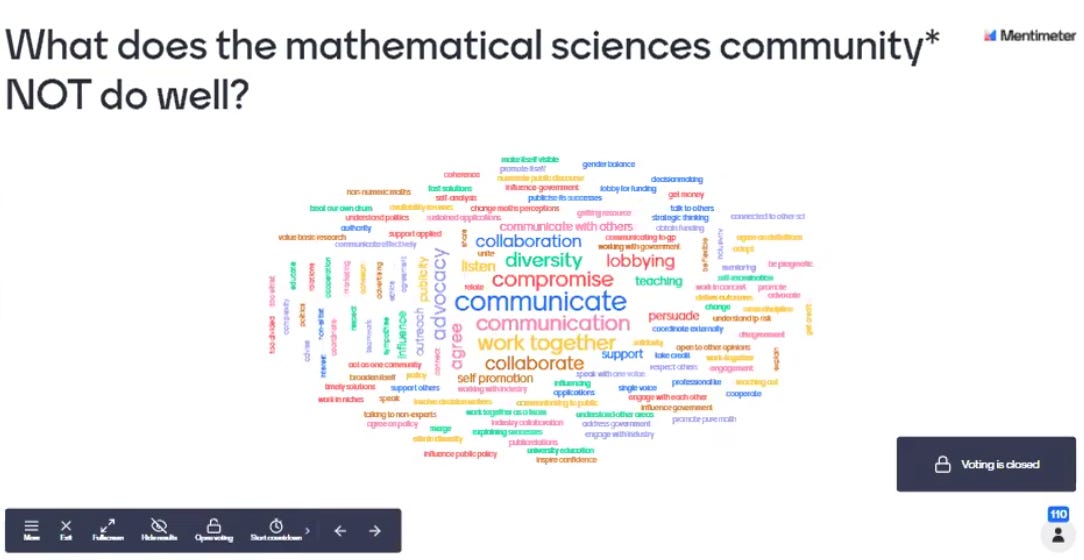
Too much can be read into these exercises, as participants can see what others write as the cloud grows and are suggested words then to submit themselves. The difference between the active verb and the activity may not distinguish personal interaction and structured propagation of ideas so much as active behaviour and community impact. But there was clearly a priority for the maths community to address, starting with working out what the issues were and who might be able to drive this forward. This post describes activity over the past couple of years as when I inquired about follow up it was clear impetus was needed, and so I persuaded Kevin McConway.
Communicating Mathematics for the Public
It was easy enough to propose a more focused consideration was needed the Isaac Newton Institute (INI) in Cambridge agreed to host a two day workshop in January 2023. Maha Kaouri of INI agreed that communication is a social topic so we required in person attendance and were rewarded with the event being fully subscribed within a couple of weeks of opening registration. And 100 people did join us in Cambridge for two days of discussion, and expressed enthusiasm for the meeting and the agenda to do more as detailed below. Moreover, Maha was able to produce a case study of the event for the INI and the leadership now describe it as ‘highly successful’.
Our choice of title specifically ‘for the public’ recognised we were not engaged with communicating to others working in mathematical sciences. But it was making a point also that there are two other areas which do broadly communicate about maths: education and outreach. The latter is where people talk about maths that interests them or attractive ideas and amusing results, without particular relation to the news. Such is maths, and generating interest in structured abstraction, canonical forms and logical reasoning is essential to sustain public support and future generations of future mathematicians. But our agenda was planned to cover other scenarios of communication, including where non-experts had questions, or important decisions.
As mathematicians are self-confessedly not good at this, we included a number of speakers who understand this communication but are not maths professionals. These included practitioners in other fields from public medicine and environmental regulation, journalists explaining maths to the public, and academic communication researchers. And we were grateful for the good will of renowned figures in our community such as Hannah Fry and David Spiegelhalter in providing their reflections on the challenge. We also settled on a discussion of the challenge in the pandemic, where mathematical models, uncertain predictions and observational biases dominated our own lives.
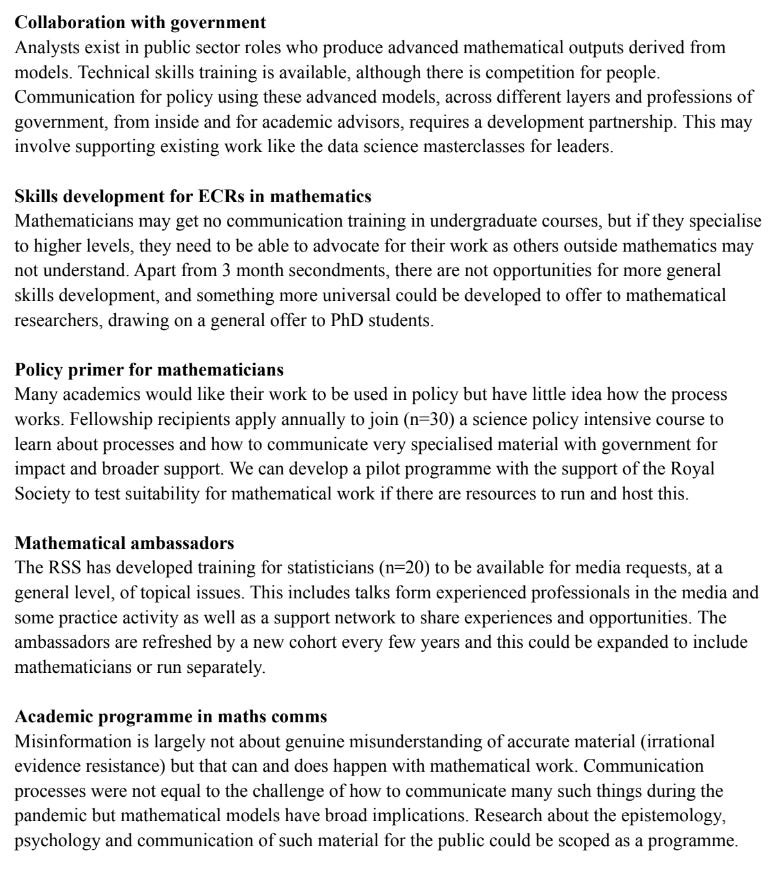
Our aim was to resolve what the community needed to do, so our evaluation included more than the typical Likert scales for the presentations, administration and venue. The five vignettes below were included as a prompt for attendees to feedback what they were interested in doing, and whether anything had been overlooked. Although none said there were any gaps in those, they could see the agenda was limited on the private sector (and included too much statistics). Unfortunately the general response, from more than 60 delegates, was that they wanted to pursue all of the proposals and typically only opted out where they were too advanced in their own career.
Building a Network
A wide programme of activity across the entire community was not a realistic (sic) proposition, especially given the lack of obvious leadership covering all sectors. So we took advantage of the recent initiative of INI to support networks and plus maths were duly funded to run the math-sci-comm in coordination with INI for two years. The membership is over 100 but still modest, and monthly topic focused discussions have around 20 participants including invited speakers from the community. And there has been substantial support from senior people for these sessions, which are relatively easy to deliver remotely on zoom for an hour. But the network was funded to run workshops as well and communication is a social activity not just transactional, so a lot of consideration has been made of what to do with those.
The network workshop in November 2024 took on the evidence gap on what effective communication was and heard from people who were developing and testing approaches. The conclusion from many academic projects is the hackneyed phrase ‘further research is needed’, but that was the main conclusion of the workshop. Very few things are known about how to communicate less basic mathematical ideas effectively, and evaluation practice in the wider scientific communication field is less systematic than it ought to be. But there were presentations about engaging the public and technical approaches to visualisation as well as some work to demonstrate deficiencies in certain simplifying strategies for public audiences.
Evidence is limited and focused on specific aspects of presentation, but these do give some very important lessons which we would like to share. Although there is a lot of evidence that making a presentation as simple as possible is the best way for more people to understand it, a perception that inconvenient information is being excluded undermines trust. And excluding uncertainty in the communication does not improve trust but more specifically people discriminate between higher and lower uncertainty, having appropriately less reliance where uncertainty is high. Furthermore, artificially limiting uncertainty (which presentation tends to be conditional on a fixed choice of model) can mislead decision makers, so scenarios are recommended in addition.
Inclusion is a more central problem than accounting for the demographic characteristics of those attending and with a place in the programme of meetings. Identifying suitable speakers from the private sector or engaging people to attend events has proven intractable as their priorities are project and value determined. But getting people who recognise a weakness in their experience with communication to network with an entirely unfamiliar group needs some work. An informal rapidfire presentation session at our first, two day event, had some value introducing more people and their interests, ahead of a more formal social dinner. Structuring the programme of meetings to involve people, and chairing to do the same is important.
Our choice to focus on the research landscape reflected a perception of progress on others of the five proposals, most notably training for early career mathematicians. Again what was lacking in the others was the wider community collaboration to deliver a substantial programme, e.g. there is a short document as a policy primer. And this came at a difficult time for government budgets, so trying to establish new activity with public sector organisations, or additionality to work with public funding was a non-starter. Some of these activities are hard to see as mathematical ambassadors are a small group who will build their visibility with more experience.
Public Interaction
Although the main conclusion around limited evidence for maths communication highlights a fairly large problem, we can see some other features emerging. One aspect is the lack of capability in municipal settings, where access to expertise internally and externally may be difficult and heavy reliance on local experience instead. ONS is running a project to support local councils, but they have been funded by the main government department as resources are not available locally and we have not enticed anyone working locally to join a workshop. But the dynamic aspect of communication, listening and responding, is particularly hard for mathematicians yet essential to engaging the public who do have an interest in our work.
Maths has been specialised as research, and separated as an activity, so that problems could be ‘thrown over a wall’, and the solution provided. That has changed substantially, with mathematical science incorporating large teams across computing and modelling working on problems from environment to health as well as more familiar physical systems. But the problems are also more dynamic in terms of ongoing work of trialling and improving possibilities, and endogenous systems which have to be updated as behaviour adapts to new constraints. And implied within this is that the work of mathematicians bears on the lives of people, through the services they use and generating evidence in support of policy decisions.
The recent pandemic highlighted the gap between political expectation of clear and simple accounts of impact of policy actions in the short term. But this applies also in climate, energy and economic modelling over a substantially longer time with more information and fewer uncertainties. So a mathematician working in the area has to be able to engage with the public, listening and responding to concerns and priorities. Indeed we need to react directly to debates in media and politics where there are gaps in technical arguments, and maths may be able to clarify potential solutions. None of this is currently taught to students so, as with engaging the media, those who have been doing it learn a craft through experience more than following a plan.
More immediately, mathematicians need to be able to talk to other experts who may disagree for a combination of technical and political priorities. Having panel discussions at workshops on maths, save for a closing discussion of ‘future plans’, is unusual but we have found it useful and we have benefited from asking Timandra Harkness taking on that role. Reasoning has a social dimension which is hard to navigate in technical disciplines, but we know that not participating leaves political arguments unchallenged, and vested interests may be presenting a partial picture. And we believe that maths is becoming more important to the kinds of decisions which are significant in the 21st century, so we need to be responsible for that.
Our next workshop on ‘listening and responding to public interest’ will be held at INI in Cambridge, UK, on 29th January 2026 - from that we will make plans for next steps in the network, including building partnerships with other interested programmes
Future Agenda
Journalism ought to be able to support our aims well but the emergence of data specialists belies the practice of most reporters talking to people not doing analysis. Indeed many like writing and chose that route for not needing an aptitude in maths.
Collaboration was a point made in the original question made about the work of the mathematical community in general, and we have found other disciplines want to work with us on our problem. But there are other academic concerns about scientific misinformation in public health, and working on modelling our physical environment.
Most academic communication research takes for granted that people understand ideas, and any misinformation is due to deception or disagreement. Experts are therefore a problem if they are not trusted (for their motivations, political association or lack of integrity) but there is little attention paid to when people are misled because they do not understand, despite the clear example of exponential growth.
Evaluation is something to attend to more seriously, both in a research programme, perhaps at INI, but also in our own work. The limited data referred to here is what we have and although we set out an initial plan we have not followed through yet, so this is the kernel of what we might develop as an academic paper on our progress.
The form of presenting these is like the conclusion of an academic paper, that ‘further research is required’. And yet we see research directed towards ends, so the pattern of ‘areas of research interest’ or ARIs, has developed for the UK government. Scoping, consulting on proposals and publishing such is indicated.